
We tend to think of risk as the possibility of losing money after investing. But there is another risk that is easier to ignore: losing purchasing power, paying more for the same foreign-currency asset, missing years of appreciation, and giving up income an asset could have generated.

The point is not that every property will rise every year. It is that waiting is not economically neutral.
Educational material - not investment, tax or legal advice. 1
- Inflation: cash can lose purchasing power
Statistics Canada reports that consumer prices were 19.9% higher in 2025 than five years earlier. Even as annual inflation cooled to 2.4% in 2024 and 2.1% in 2025, the higher price level did not reverse.

If CAD $100,000 sits for years earning less than inflation, the account balance may still look safe while its real purchasing power erodes. Liquidity is valuable; permanent inactivity is not automatically conservative.
Inflation is the first cost of waiting. It should be analyzed separately from currency movements.
Educational material - not investment, tax or legal advice. 2
- Currency: the same US$ asset can become more expensive in CAD
CAD required to buy US$1
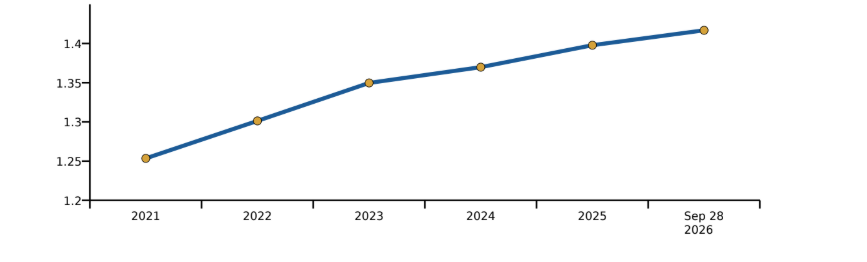 In 2021, the Bank of Canada's annual average was 1.2535 CAD per US dollar. On September 28, 2026, the daily rate was 1.4168. A US$300,000 property therefore illustrates the currency effect clearly:
 The property did not need to appreciate by a single US dollar
for a Canadian buyer to require almost CAD $49,000 more.
- Appreciation: time in the market can matter
For illustration, assume 5% annual compound appreciation. This is not a forecast. It is a scenario. For context, FHFA's U.S. purchase-only index shows a 33.41% national increase over the five years ending 2026 Q2 - roughly 5.9% annualized.
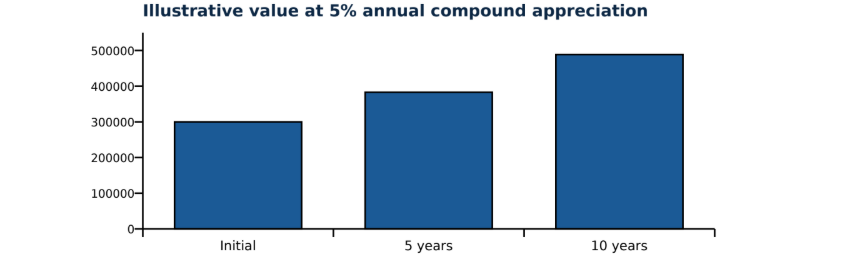
 Combine that illustrative five-year appreciation with the 2026 exchange rate and the property would be worth about CAD $542,471 versus an initial CAD $376,050 cost - a nominal difference of about CAD $166,421, before costs, taxes and financing.
- Rent: the income you never collected cannot be recovered later
A well-selected investment property can potentially generate cash flow while the underlying asset is held. A 4% net annual yield on an initial US$300,000 value would represent US$12,000 per year, or US$60,000 over five years, if occupancy and expenses performed as assumed. This is an illustration, not a promise.

- Leverage: control a larger asset with less equity US$300,000 property

Leverage can magnify gains - and losses.
With 30% equity, US$90,000 controls a US$300,000 asset. If that asset appreciates, the gain is measured on the full property value, not only on the equity contributed. The reverse is equally important: leverage also magnifies losses, interest costs and refinancing risk.
Educational material - not investment, tax or legal advice. 5
- Yes, real estate has risk - and markets move in cycles
Property values can decline in certain cycles. Rental demand can soften. Interest rates, taxes, regulations, insurance and maintenance costs can change. Some projects will outperform; others will disappoint. International investing also adds currency, legal and liquidity considerations.
That is an argument for better selection and better due diligence - not for assuming that standing still has no cost.
The more useful question is not simply: “What if I invest and prices fall?” It is also: “What happens to my purchasing power and my portfolio if I wait another five years?”
Investing is not about buying anything at any price. It is about putting capital to work deliberately: selecting markets with real demand, understanding the exit strategy, evaluating cash flow, diversifying exposure and giving time the opportunity to work in your favour.
Waiting for perfect certainty can feel safe. Financially, however, it is still a choice - and sometimes an expensive one.

Sources: Bank of Canada, Annual Average Exchange Rates (2021-2025) and Daily Exchange Rates (Sep. 28, 2026); Statistics Canada, Consumer Price Index Annual Review 2025; U.S. Federal Housing Finance Agency, FHFA HPI Summary Tables, 2026 Q2.
Illustrative scenarios do not guarantee future performance. Returns vary by market, property, financing, taxes, expenses and currency movements. © 2026 Monika Texier. All rights reserved.